Adaptive Digital Twin
Simulation & prediction
The signals a bioreactor gives you — dissolved oxygen, pH, temperature, off-gas — are not the things you actually care about. Biomass, metabolic state, and whether a batch will meet spec are inferred, not measured. The twin closes that gap: it estimates what you cannot measure, predicts where a batch is heading, and recommends how to keep it on track.
The problem
A bioprocess is a living system, and it rarely runs the same way twice. Two batches with identical setpoints can diverge because the biology drifted, a raw-material lot changed, or the same recipe behaves differently at 20 L and 2,000 L.
The instruments in the tank report a handful of physical variables in real time. The variables that decide the outcome — cell density, substrate limitation, product quality — arrive hours later from offline assays, if at all. By then the window to intervene has usually closed. So process teams spend the day reacting to what already happened instead of steering what is about to.
Our approach
Soft sensors — infer the unmeasured
The twin correlates the real-time signals you have (DO, pH, off-gas, feed rates) with the states you cannot measure online — biomass / OD600, substrate, metabolic rates. Between offline samples, it keeps a live estimate of the culture’s actual state, not just its instrument readings.
Hybrid models — mechanism plus data
Purely data-driven models need mountains of runs and break outside their training range; purely mechanistic models miss what we do not yet understand about the biology. We build hybrid models: a mechanistic backbone (mass balances, growth kinetics, oxygen transfer) with machine learning filling the parts that resist first-principles description. That keeps mechanistic interpretability, adapts to real data, and needs fewer experiments to become useful.
The golden envelope — a tunnel, not a line
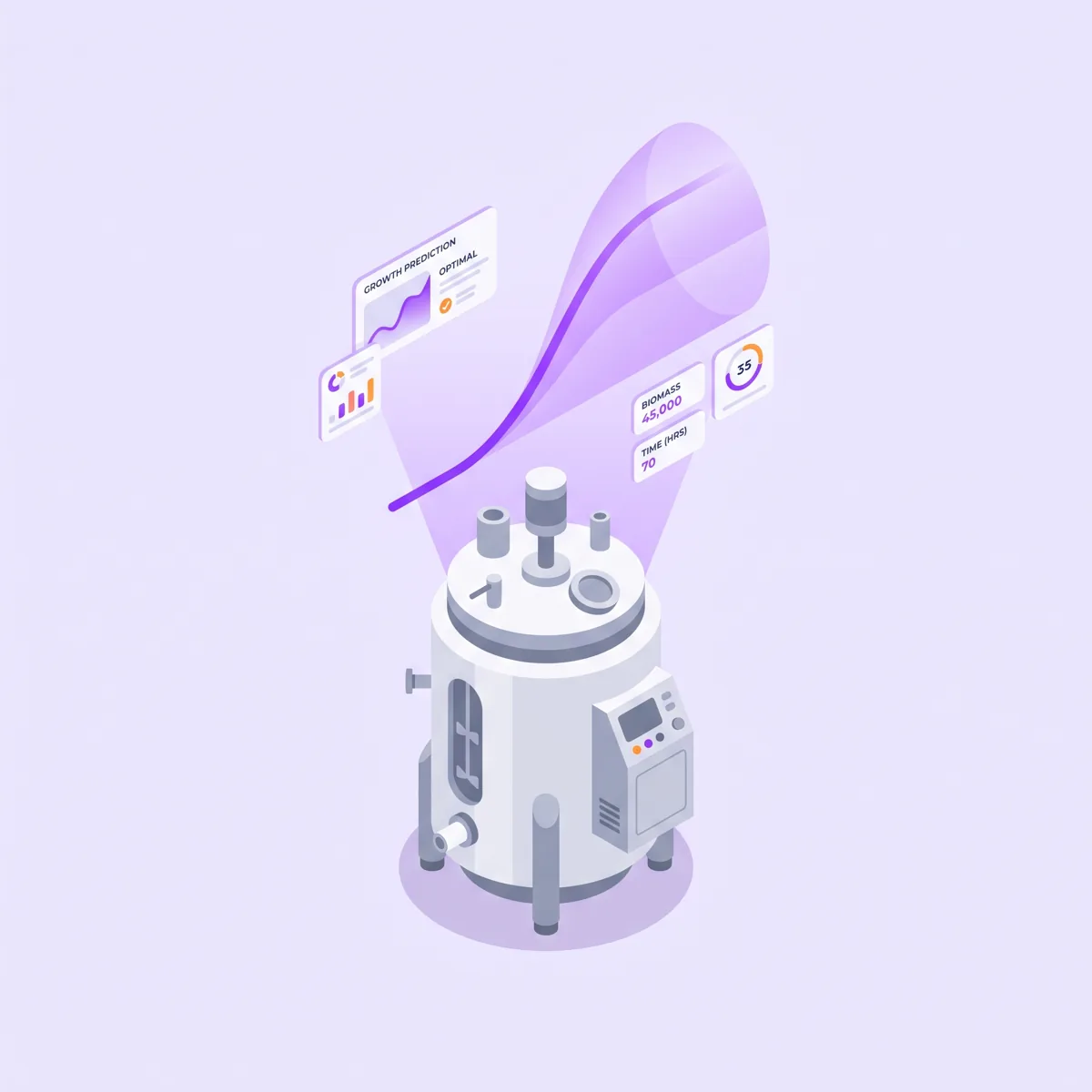
A golden batch is not one perfect curve; it is a statistical envelope. From multivariate analysis of historical good runs, the twin builds an expected trajectory for each critical parameter with an uncertainty band around it — a process-monitoring tunnel. A running batch is projected against that envelope live, so drift toward off-spec is visible while there is still room to act — not after release testing.
Forecasting with confidence
The twin does not just place today’s point on a chart. It projects each critical parameter forward with confidence bands, so you see where a batch is heading and how sure the model is about it.
From prediction to action
A forecast only matters if it changes what you do. The twin turns its prediction into a concrete, prescriptive suggestion — a feed, DO or acid setpoint change — to bring a batch back toward its envelope. That is the path from monitoring, to decision support, toward closed-loop control.
Connecting parameters to quality
Underneath, the twin links the parameters you can control (critical process parameters) to the quality attributes you are accountable for (critical quality attributes) — the relationship at the heart of Quality by Design.
Modica is an R&D-stage company: parts of this are running today and parts are in active development. We would rather show you the real system than a polished promise.