Adaptive Digital Twin
Connectivity — the foundation
A digital twin is only as good as its data. What a twin needs is scattered across incompatible protocols and, worse, arrives as a flat list of tags with no shared meaning. The connectivity layer turns that into a clean, standardized, live model of the plant — so the twin reasons about a real bioreactor, not a spreadsheet of registers.
The problem
Historians and SCADA were built to run and record a plant, not to hand a model a clean, typed picture of it. A working twin needs live, complete, correctly-labelled data — and getting it is where most digital-twin efforts quietly stall.
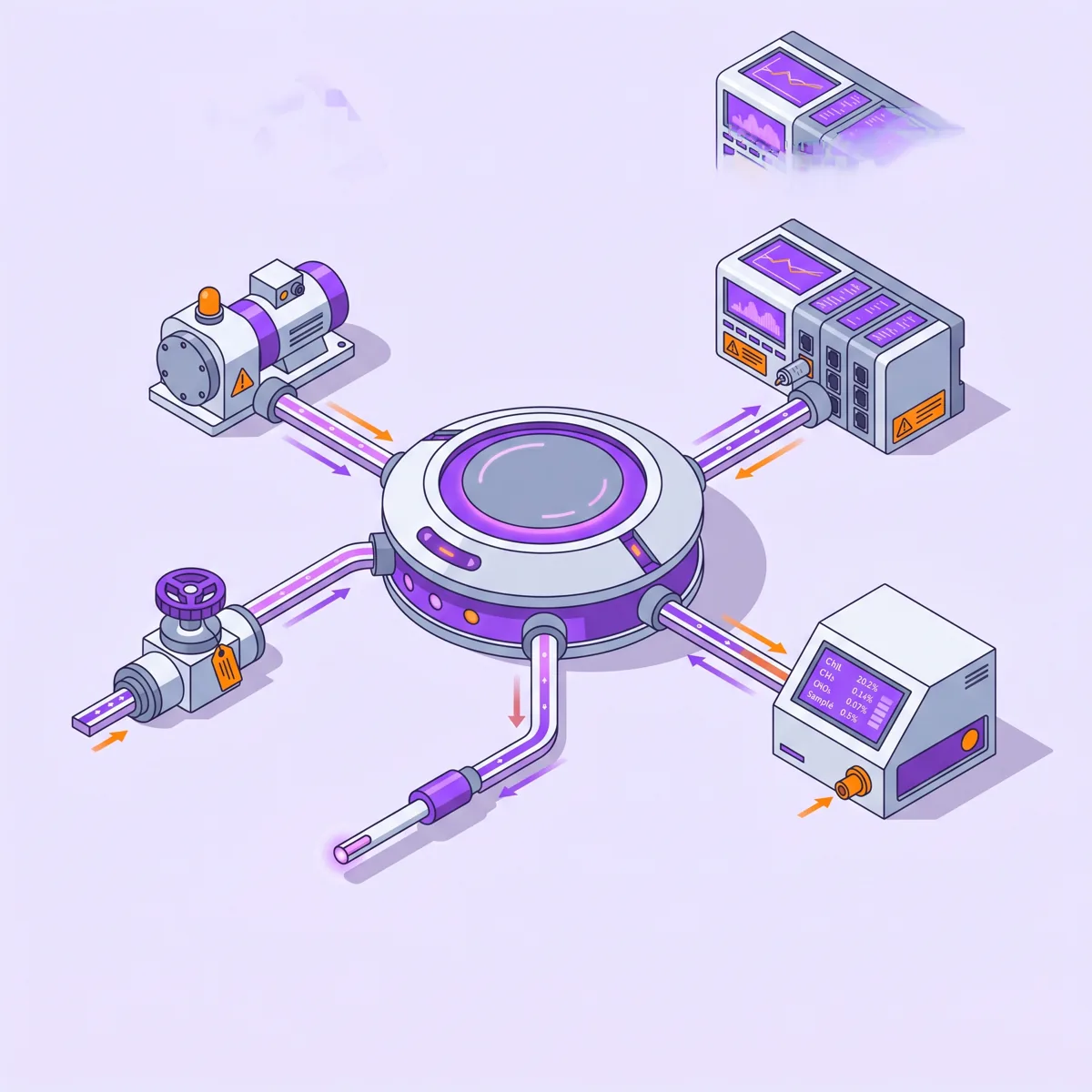
Sources speak different languages: OPC UA on newer equipment, Modbus TCP and Siemens S7 on installed skids, MQTT from edge devices, MTP on modular units. Each exposes its own tag list, with local names and no shared semantics. Integrating a new instrument or skid becomes a bespoke project — and the model inherits whatever chaos the tag list contained.
Our approach
One hub, many protocols
A driver per protocol — OPC UA, Modbus TCP, S7 / Siemens, MQTT, MTP — so a new source is a configuration, not a project. Connections can be redundant, and a watchdog flags stale or dropped data before it reaches the model.
Standardized types via MTP
We map raw tags onto reusable, typed modules following the Module Type Package standard (VDI/VDE/NAMUR 2658, published as IEC 63280) — the plug-and-produce approach the process industry uses to integrate modular skids independently of the controller vendor. A pump, a valve, an analyzer becomes a known type with defined signals, not an anonymous block of registers.
Automatic device detection
Define a standard once and matching equipment populates the inventory on its own — so scaling from one reactor to a fleet is not a manual re-mapping exercise every time.
A monitoring channel, alongside control
In the spirit of NAMUR Open Architecture (NOA), the connectivity layer reads plant data through a second, monitoring-oriented path — so the twin gets what it needs without reaching into the control system that keeps the process safe.
Diagnostics & governance
Watchdogs on stale data, redundant connections, and role-based access — operator, engineer, admin — with an audit trail, so the data feeding the twin is observable and accountable.
Connectivity is one feature, not the product. It exists so the twin can be trusted — the value is the simulation and prediction it enables.