R&D
We lost the batch. The model was 94% accurate.
Why classical deep learning fails on 10–50 bioprocess runs, and how physics-informed neural networks use mass balance and kinetics to turn sparse data into physically consistent models.
The validation metrics looked fine: R² of 0.94 across 12 historical runs. What the model had never seen was a dissolved oxygen dip below 20% at hour 48 of a 21-day culture. When it did, it extrapolated into a regime that violated basic mass balance. High accuracy on training data is not the same as knowing biology.
At commercial scale, that distinction costs millions.
The real bottleneck isn’t technology. It’s data scarcity
Process engineers in biopharma know the situation well: a single fed-batch CHO run can take 14–21 days. A typical upstream development campaign generates perhaps 10–50 usable time-series experiments in total.
That number is a death sentence for classical deep learning.
A standard LSTM or feedforward network trained on 12 batches will memorise artefacts, not biology. It will confidently extrapolate into conditions it has never seen and produce predictions that violate mass balance — predicting more product than substrate fed. The network simply has no reason to respect the underlying science.
The engineering answer: teach the network physics
Physics-informed neural networks (PINNs) are not a new architecture; they are a new training strategy.
The core idea, formalised by Raissi et al. (2019), is elegant. Instead of training a network to minimise only the data-fitting error, you add a second term to the loss function: the residual of the governing differential equations. The network must satisfy both the measurements and the physics simultaneously.
In a bioreactor context, that means encoding equations such as Monod kinetics for microbial growth, or a mass-balance ODE for substrate consumption, directly into the loss:
L_total = L_data + λ · L_physicswhere L_physics penalises any prediction that violates, say, dX/dt = μ(S) · X − D · X.
The model can no longer produce physically absurd outputs. Physics acts as a hard regulariser that replaces the thousands of missing data points.
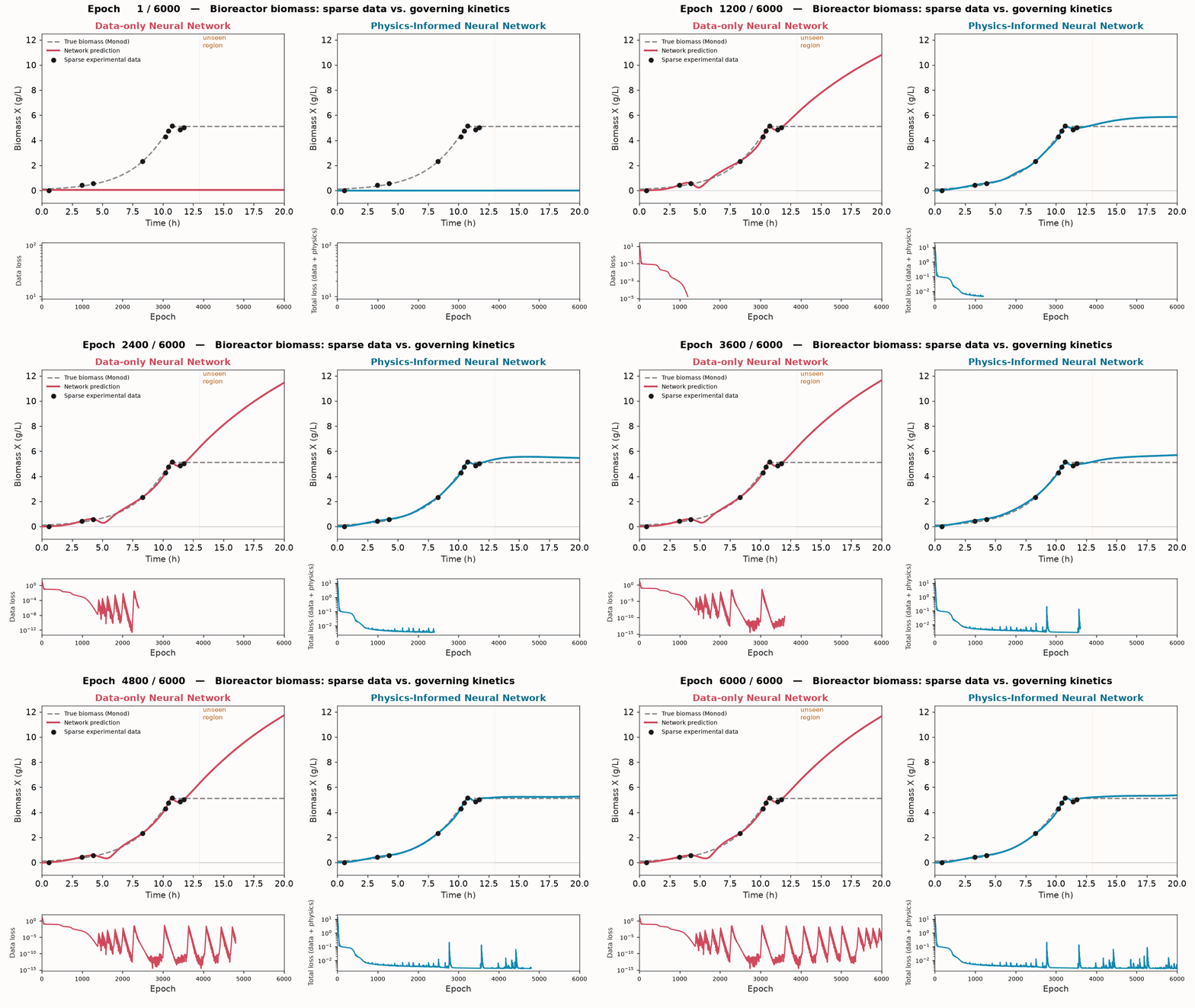
What this looks like in practice
The engineering workflow for a PINN-based bioprocess model typically involves three layers:
- Mechanistic knowledge encoding. The process scientist encodes the known ODE structure (e.g. Monod growth, substrate uptake, product formation) into the physics loss term. This is grey-box modelling: you don’t need to know all kinetic parameters, just the form of the equations.
- Neural network as kinetic approximator. Where mechanistic knowledge is incomplete (e.g. product inhibition, time-varying metabolic shifts), a sub-network learns the unknown kinetics purely from data. A dual-ANN PINN structure — one network for state trajectories, one for reaction kinetics — has shown particular promise for decoupling these concerns (Thirugnanasambandam et al., 2025).
- Sparse-data training with a physics constraint. This is where the value is realised. Thirugnanasambandam et al. (2025) demonstrated that a PINN trained on just 9 of 15 available experiments could accurately predict the optimal protein secretion scenario in a high-dimensional fed-batch benchmark. A pure black-box ANN on the same data would overfit within the first epochs.
Evidence from the lab bench to industrial scale
The research community is moving fast:
- Bangi et al. (2022) demonstrated PINN-based hybrid modelling for β-carotene production in Saccharomyces cerevisiae at lab scale, using neural ODEs to encode known fermentation kinetics while letting the network learn the uncharacterised dynamics. The hybrid model was more accurate than the existing kinetic model.
- Zhu et al. (2026) proposed a calibration-free PINN framework that jointly estimates key quality indicators and unmeasurable internal system states. It was validated on industrial penicillin fermentation across multiple strains and process conditions, demonstrating robust extrapolation under parameter drift and limited data.
The common thread across the literature is consistent: PINNs incorporate prior knowledge to decrease data dependency while improving model transparency and generalisation — precisely the property missing from purely black-box approaches.
The business value: more than better predictions
For a biopharma company, the implications extend well beyond modelling accuracy:
- Faster process development. Fewer confirmation experiments are needed when the model is constrained by known physics. This directly compresses development timelines, a critical edge in competitive therapeutic pipelines.
- Regulatory defensibility. A model that can show its predictions are anchored to mass balance and kinetic principles is far easier to justify in a regulatory submission (ICH Q8/Q10) than a black-box neural network. The physics constraint is an audit trail for the model’s behaviour.
- A path to real-time digital twins. PINNs that continuously re-estimate kinetic parameters from live PAT data (Raman spectroscopy, capacitance probes) are the technical backbone of true adaptive process control — moving from batch review to in-run intervention.
The cost equation is simple: the more expensive each experiment, the more valuable every piece of prior physical knowledge becomes.
The honest caveat
PINNs are not a universal solution. Training can be unstable when physics and data gradients conflict — a known challenge when ODE systems are stiff, with fast and slow dynamics coexisting. Careful loss weighting and curriculum training strategies (training the data loss first, then introducing the physics constraint) are active areas of research. PINNs are a powerful tool for a specific, well-defined problem, not a replacement for domain expertise.
A question for the community
We are at an inflection point where decades of accumulated kinetic knowledge (Monod, Droop, Andrews, product-inhibition models) can be directly encoded into neural networks, turning sparse bioprocess data into robust, physically consistent models.
To process engineers and data scientists working in biopharma: what is your current strategy for bridging the gap between data-scarce upstream development and predictive modelling? Are you working with hybrid models, PINNs or purely mechanistic frameworks? What is holding adoption back in your organisation?
Sources
- Raissi, M. et al. (2019). Physics-informed neural networks. Journal of Computational Physics, 378, 686–707.
- Bangi, M.S.F., Kao, K. & Kwon, J.S.-I. (2022). Physics-informed neural networks for hybrid modeling of lab-scale batch fermentation for β-carotene production using Saccharomyces cerevisiae. Chemical Engineering Research and Design. DOI: 10.1016/j.cherd.2022.01.041
- Thirugnanasambandam, M. et al. (2025). A physics-informed neural network (PINN) framework for generic bioreactor modelling. Computers and Chemical Engineering, 203, 109354.
- Zhu, H. et al. (2026). Calibration-free physics-informed neural networks for adaptive state inference in bioprocesses. AIChE Journal, 72(6). DOI: 10.1002/aic.70284
Originally published on LinkedIn on 27 July 2026.